August 10, 2026
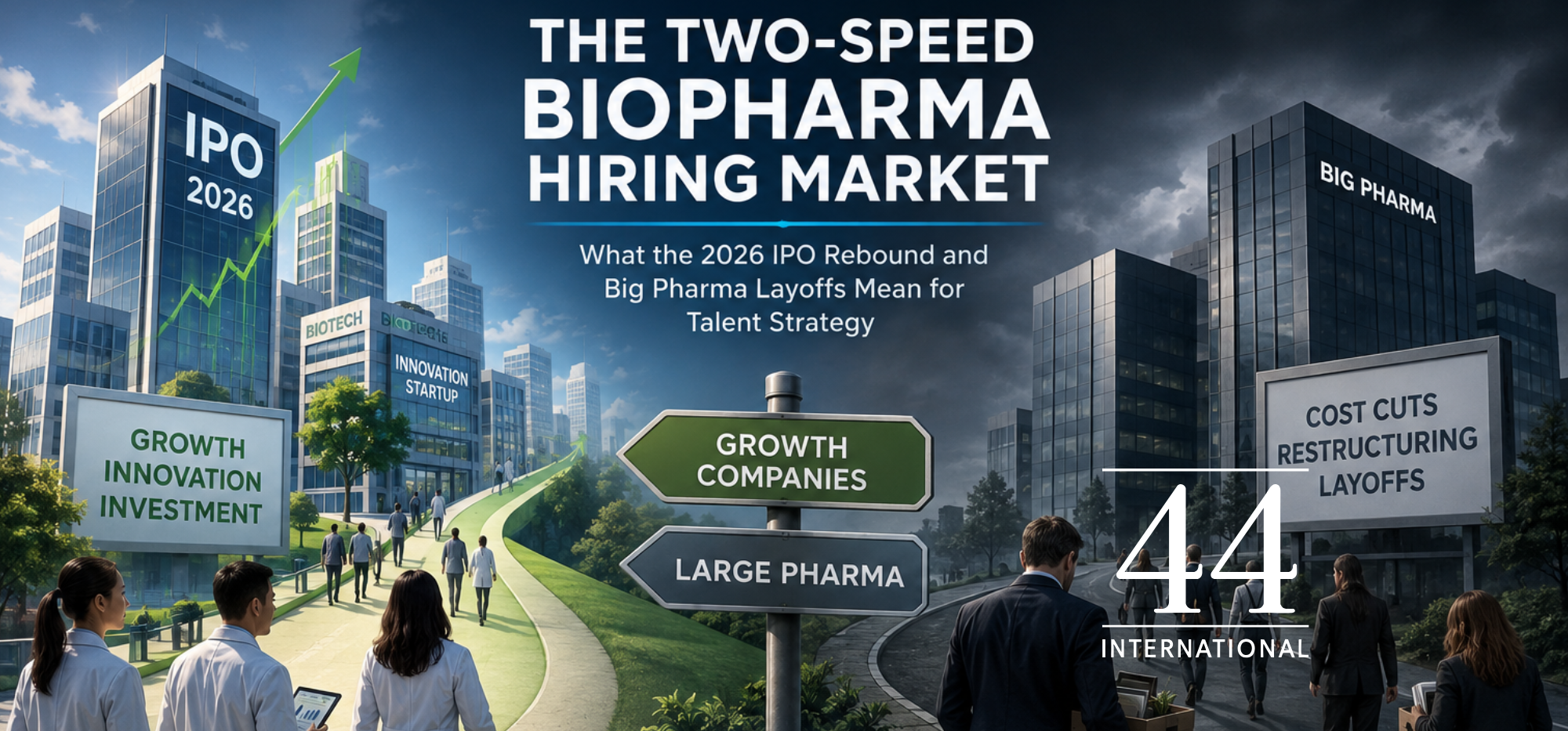
The biopharma talent market in 2026 is not one market. It is two.
Large pharmaceutical companies continue restructuring their workforces at a pace not seen in years, while the biotech IPO window has reopened with a force that surprised even the most optimistic market observers. These two forces are happening simultaneously — and they are pulling the talent market in opposite directions.
For hiring organizations and for life sciences professionals, understanding the mechanics of this split is no longer optional. The strategic decisions made in the second half of 2026 will determine which companies secure the specialized talent they need and which candidates position themselves ahead of the next growth cycle.
The scale of the biotech IPO recovery in 2026 has been striking. In the first half of the year alone, 18 biotech companies went public, raising a combined $5.0 billion — a total that already exceeds every full-year figure recorded from 2022 through 2025. For context, only eight biotech IPOs occurred across all of 2025.
Deal size has shifted just as dramatically. The median raise in 2026 reached $287.5 million, more than double the same period last year and the highest median since 2021. Eleven of the thirteen newly public biotech companies secured at least $250 million in IPO proceeds. Two companies — Parabilis Medicines and Kailera Therapeutics — eclipsed Moderna's previous record for the largest initial share sale in biopharma history.
Behind the IPO figures, private M&A activity has been equally active. In a twelve-day window in March 2026 alone, seven biopharma transactions above $1 billion were announced, representing approximately $29 billion in combined deal value.
These are not isolated events. They represent a structural shift in capital availability across the sector — and capital availability is what drives hiring.
When a company raises $300 million in an IPO, it does not sit on that capital. It builds. It hires clinical operations leads, regulatory affairs specialists, CMC directors, medical affairs teams, and commercial strategy executives. It does this quickly, because the clock starts the moment the prospectus closes.
The IPO rebound is not just a financing story. It is a talent demand story.
The restructuring picture at large pharmaceutical companies looks severe on its surface. The 17 pharmaceutical organizations with at least $20 billion in annual revenue collectively reduced their workforces by more than 22,000 positions in 2025 — a 47% increase over the prior year. In 2026, an additional 15,405 positions have been cut across 25 healthcare and pharmaceutical companies, with Takeda's 4,500-person reduction representing the largest single announcement of the year.
Pfizer reduced its workforce from approximately 88,000 to roughly 75,000 by late 2025. Novo Nordisk announced plans to cut approximately 9,000 positions — roughly 11.5% of its global workforce — as part of a restructuring targeting $1.26 billion in annual savings. Merck launched a restructuring aimed at generating $3 billion in annual cost savings by 2027.
The scale is real. But the interpretation matters.
The majority of these reductions are concentrated in duplicated corporate infrastructure, legacy commercial infrastructure, and administrative functions made redundant through acquisitions. They are not, in most cases, cuts to research, clinical development, or high-priority therapeutic programs. In many instances, large pharmaceutical companies are simultaneously releasing headcount in one area and competing aggressively for specialized talent in another.
This pattern — restructuring generalist functions while accelerating investment in targeted therapeutic areas — reflects the core strategic pressure driving these organizations: a $300 billion patent cliff projected to erode prescription drug revenues between 2025 and 2030. Companies under that kind of revenue pressure are not pulling back from innovation. They are consolidating to fund it more efficiently.
The nuance that matters for talent strategy is this: a pharmaceutical company announcing layoffs may still be one of the most active hirers in a given specialized function. Reading the headline without reading the underlying strategy creates a misleading picture of where the market actually stands.
The concurrent pressure of large pharma restructuring and biotech expansion is reshaping the available talent pool in ways that benefit neither side of the market as cleanly as it might appear.
For biotech companies ramping hiring following an IPO or a significant funding round, there is an assumption that pharmaceutical layoffs will produce an accessible pipeline of experienced candidates. In practice, the professionals most sought after by growth-stage biotech — senior regulatory strategists, experienced CMC leaders, late-stage clinical operations executives, and translational medicine specialists — are rarely the same profiles being displaced by large pharma restructuring.
The positions being cut tend to sit in generalist, commercial, and administrative layers. The positions biotech companies need filled are highly technical, deeply specialized, and often require a combination of therapeutic area expertise, regulatory experience, and the operational agility that comes from having worked in a resource-constrained environment.
The result is a paradox that is defining 2026 hiring dynamics: a market in which layoffs are generating significant candidate volume at the generalist level while acute shortages persist at the specialist level. Organizations searching for senior regulatory affairs leaders, cell and gene therapy CMC experts, and first-in-class submission specialists are reporting search timelines of six to nine months even in an environment where industry-wide restructuring headlines suggest an abundant candidate market.
Director and VP-level clinical operations roles increased 31% year-over-year in 2026. VP Regulatory Affairs searches grew 22%, with first-in-class submission experience emerging as the single most requested differentiator. Translational medicine leadership grew 24%.
These are not the profiles being displaced by pharmaceutical restructuring in any material volume.
For organizations competing for specialized life sciences talent in 2026, the strategic environment has shifted in ways that require a recalibrated approach.
Speed is no longer a preference. It is a competitive variable. When multiple organizations are searching for the same specialized profiles simultaneously — as is currently the case in regulatory affairs, cell therapy operations, and late-stage clinical leadership — the company that moves from identification to offer in the shortest timeline secures the best candidates. Extended hiring cycles, while common in pharmaceutical environments, are a structural disadvantage in a market where the top candidates are actively fielding multiple conversations.
Employer positioning matters more than it did two years ago. Specialized candidates — particularly those in high-demand therapeutic areas — are evaluating pipeline maturity, funding security, leadership credibility, and the clarity of an organization's development roadmap before making career decisions. In a two-speed market, candidates have genuine optionality. Companies that cannot articulate a clear growth narrative are losing ground to those that can.
Post-IPO companies face a specific talent strategy challenge. The twelve to eighteen months following a public market debut involves a fundamental shift in operational complexity: quarterly earnings obligations, SEC compliance requirements, investor relations demands, and the pressure of managing clinical data readouts against stock price volatility. Organizations that have not hired experienced public company leadership before the IPO roadshow often find themselves managing these demands with teams built for a different stage of the business. This is a talent strategy failure that is easier and less expensive to address before the IPO than after.
M&A creates both disruption and opportunity. As acquisition activity accelerates — seven transactions above $1 billion in just twelve days this March — the integration challenge intensifies. Companies acquiring pipelines need leaders who can absorb new assets, align operational infrastructure, and maintain momentum across programs with different histories, teams, and regulatory positioning. This is a distinct capability that is not universally available, and hiring for it proactively is a meaningful strategic differentiator.
For talent navigating this market, the most important insight is also the most counterintuitive: a market filled with layoff announcements is not necessarily a market of reduced opportunity. It is a market of shifted opportunity.
Generalist experience in pharmaceutical commercial operations or corporate functions faces a more competitive environment than at any point in the last decade. Specialized technical expertise — particularly in regulatory affairs, advanced manufacturing, clinical pharmacology, translational medicine, and high-complexity biologics — continues to see demand that outpaces supply.
This divergence creates a clear strategic priority for professionals at every level of their careers: depth of specialized expertise translates to market resilience in a way that breadth of generalist experience does not, at least in this cycle.
For professionals currently navigating displacement from large pharmaceutical restructuring, the question is not simply where the next available role sits. The more productive question is where specialized expertise intersects with the areas of the market currently experiencing genuine growth — and how to position for that intersection before the most active hiring windows close.
The companies making strategic hires in the second half of 2026 are largely concentrated in clinical-stage biotech with recently funded programs, organizations building in the GLP-1 and metabolic therapeutics space, AI-enabled drug discovery platforms scaling toward clinical execution, and advanced manufacturing operations in cell therapy, biologics, and radiopharmaceuticals. Each of these segments is adding headcount in highly specific ways, and the candidates best positioned to access those opportunities have clarity about where their expertise maps to those needs.
EY analysts project that the total percentage of biopharma layoffs in 2026 will likely remain below 5% for the full year — a meaningful deceleration from 2025's pace. The sharpest reduction in layoff activity was already visible in the second quarter of 2026, extending a trend that began in late 2025.
That trajectory, combined with a biotech capital market that has reopened with more sustained momentum than most observers anticipated, suggests that the second half of 2026 and into 2027 will see continued bifurcation rather than convergence. Large pharmaceutical organizations will continue optimizing their structures. Growth-stage biotech companies will continue building theirs.
The professionals and organizations that perform best in this environment will be those that resist the temptation to read industry-wide headlines as a reliable proxy for their own market position — and instead focus on where specialized capability, strategic clarity, and hiring speed intersect.
That intersection is where the real market is being decided.
44 International is a specialist recruitment firm focused on life sciences, pharma, biotech, MedTech, and CRO/CDMO talent. If your organization is navigating the strategic hiring challenges of the current market, reach out to our team.

© All rights reserved