September 21, 2026
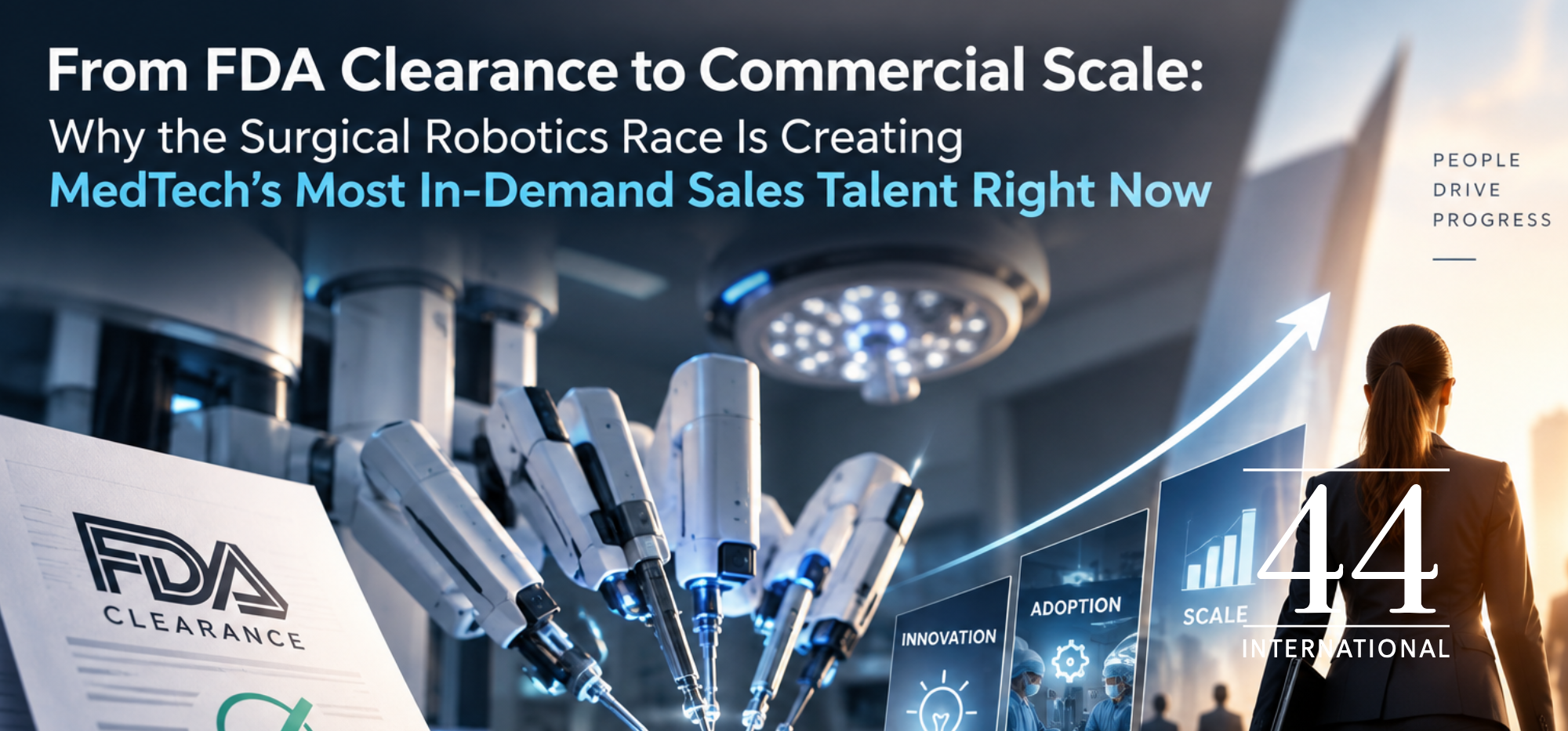
The surgical robotics race in the United States isn't just about who has the best platform. It never really was. It's about who can build the commercial infrastructure to deploy, support, and scale that platform across a healthcare system that is, at its core, relationship-driven, risk-averse, and slow to change.
Two events in September 2026 illustrate exactly how fast that pressure is building — and why the demand for surgical robotics commercial talent is becoming one of the most acute hiring challenges in US MedTech right now.
On September 16, 2026, Medtronic received FDA clearance for the LigaSure RAS Maryland instrument on its Hugo robotic-assisted surgery (RAS) system. This is the first robotic-driven energy sealing device cleared for the Hugo platform — a meaningful expansion of what the system can do in the operating room, and another step in Medtronic's broader effort to build out Hugo's US commercial portfolio across soft-tissue indications in general and gynaecologic surgery.
Less than three weeks earlier, on September 1, Enovis announced a binding offer to acquire eCential Robotics for approximately €155 million ($180 million), adding surgical robotic automation capabilities to its ASTRA enabling technology platform. In doing so, Enovis joined a growing list of orthopaedic companies — including Stryker with Mako and Johnson & Johnson with VELYS — that have reached the same conclusion: surgical robotics is no longer a differentiator. It is the baseline requirement for competing seriously in the US orthopaedic market.
Different companies. Different strategies. The same underlying pressure. And the same hiring problem sitting right behind it.
Every FDA clearance creates a commercial obligation that most press releases don't capture. When a new instrument or indication is cleared for a robotic platform, the work doesn't stop at the regulatory milestone — it starts there.
Placing a robotic system in a hospital and getting it to clinical volume requires a field presence that is both clinically credible and commercially capable. Surgeons need to be proctored through a structured learning curve. OR teams need hands-on technical support. Hospital administrators need a business case. Value analysis committees need outcomes data. And the sales representative driving the account needs to hold all of that together across a deal cycle that, for capital equipment in a major US health system, can easily span 12 to 18 months.
That is a very specific professional profile. And the pool of people who genuinely have it — across soft tissue, general surgery, gynaecology, and orthopaedics — is considerably smaller than the number of open roles currently chasing them.
The commercial talent shortage in surgical robotics is not abstract. It shows up in specific roles that MedTech companies are consistently struggling to fill at the right experience level.
These are the territory drivers — the people responsible for new system placements and procedure volume growth within a defined geography. The best ones already have established relationships at major health systems and IDNs, understand the surgeon community in their territory, and know how to navigate a multi-stakeholder hospital sale from first conversation to signed contract. They are actively courted by multiple companies simultaneously, and they know it.
Arguably the most urgently sought profile in surgical robotics right now. FCEs are in the OR for every procedure, supporting the surgical team in real time during the ramp-up period after a new system is placed. Their ability to build clinical confidence in the platform — surgeon by surgeon, case by case — directly determines how quickly a hospital reaches full utilisation. They need deep procedural knowledge, technical fluency with the platform, and the interpersonal skills to operate effectively inside a high-pressure surgical environment. That combination is rare.
These professionals design and run the structured programmes that take a surgeon from initial exposure to consistent, independent use. Without this role executing well, procedure adoption stalls, volume targets are missed, and the commercial return on a multi-million dollar system placement is delayed. Training leads need clinical background, adult learning principles, and the ability to work across multiple hospital accounts simultaneously.
The hospital buying process for a robotic surgical system is not a transactional sale. It involves departmental stakeholders, value analysis committees, finance teams, and C-suite approval. Capital equipment reps who have navigated this process before — and who understand how to build an outcomes-based business case that survives committee scrutiny — are in consistent demand across the US surgical robotics market.
As more companies enter the surgical robotics space through acquisition — as Enovis is now doing with eCential — there is growing demand for commercial leaders who can integrate newly acquired technology into existing US sales teams, account structures, and go-to-market models. This is a nuanced role that requires both strategic understanding of the commercial landscape and the operational ability to execute a transition without losing account momentum.
The US surgical robotics talent market is no longer in its early innings. Intuitive Surgical has spent decades building the commercial playbook, and the industry has spent years producing the talent trained against it. That talent base is now being pulled in multiple directions simultaneously, as established players like Medtronic deepen their US presence, orthopaedic companies accelerate robotics adoption through M&A, and newer entrants compete to staff their commercial teams from a finite pool of experienced professionals.
The result is a candidate market where experienced robotic surgery sales professionals are fielding multiple offers, counteroffers are routine, and candidates with a track record on one of the established platforms can be selective about where they move. The profile that companies are asking for is also becoming more specific — clinical depth in the right indication, existing OR relationships with the right surgeon community, and experience inside a major health system capital sale. That intersection narrows the field considerably.
If you are building or scaling a surgical robotics commercial team in the US, the window to move quickly and decisively on talent has narrowed. The companies that are getting ahead of this challenge share a common approach: they treat commercial talent acquisition as part of their launch and expansion strategy, not as something that starts after a clearance comes in or an acquisition closes.
They map territory structures before regulatory decisions land. They identify the candidate profiles they need — not just the job titles — six to nine months before the roles need to be filled. And they move fast when the right candidate is available, because in this market, a slow process is an expensive one.
The surgical robotics race in the US will be decided by commercial execution. Medtronic's Hugo LigaSure RAS clearance and Enovis's acquisition of eCential Robotics are not isolated events — they are two data points in a pattern of sustained, accelerating expansion that is placing real pressure on a US commercial talent market that was already stretched.
The demand for surgical robotics sales specialists, field clinical engineers, training leads, and capital equipment reps is not a projection. It is happening now, across multiple platforms, across multiple indications, and across a US healthcare system that is increasingly committed to robotic-assisted surgery as the standard of care.
The companies that treat that talent demand as the strategic variable it is will be the ones who scale commercial operations fastest — and convert regulatory wins into lasting clinical and commercial outcomes.
44 International places specialist commercial talent across the US surgical robotics market. Whether you are building a robotic surgery team from the ground up or looking to make your next move within one, we would like to hear from you. Get in touch with our team.

© All rights reserved