July 27, 2026
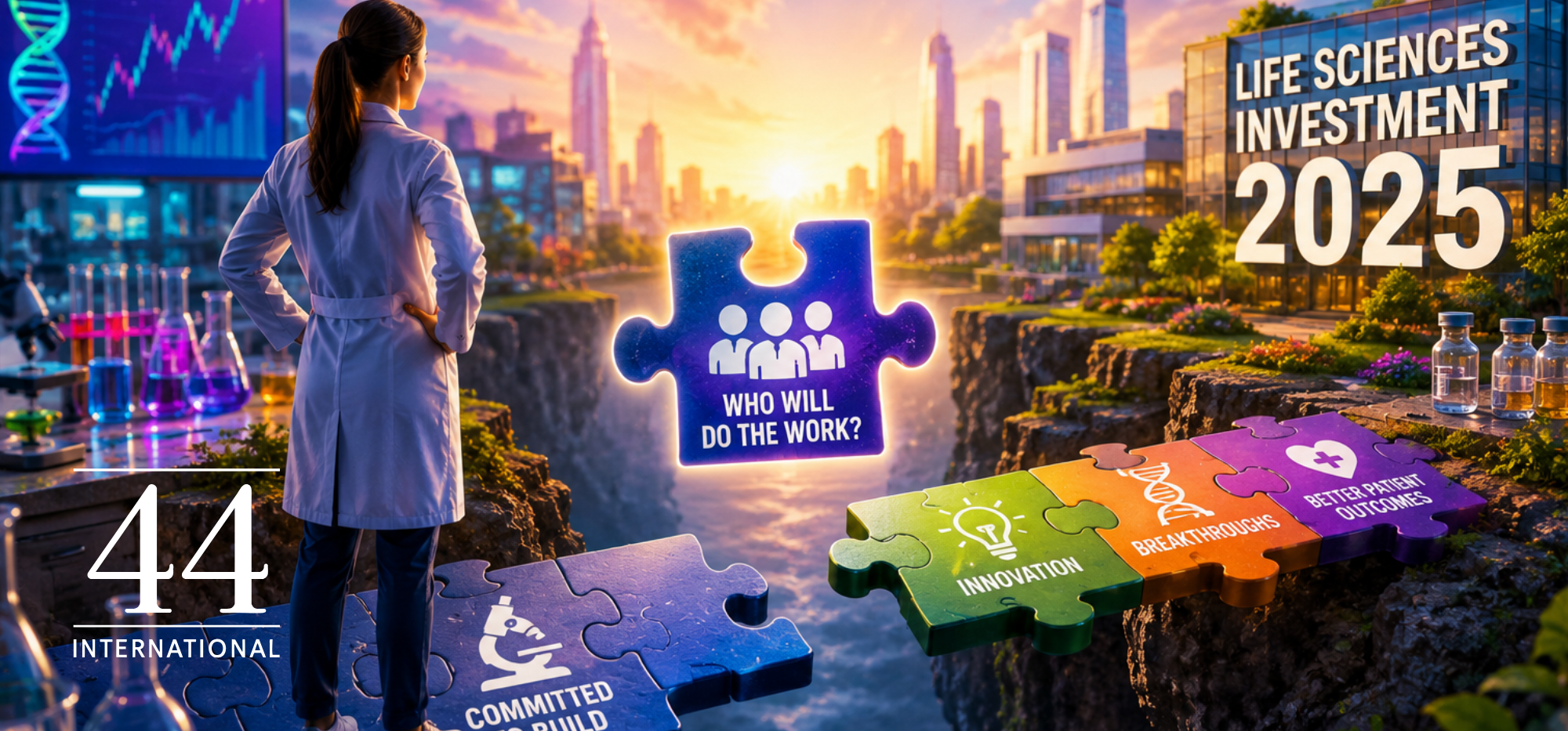
The money is there. The ambition is there. The pipelines are bursting with promise — from next-generation cell therapies to AI-powered drug discovery platforms that would have seemed like science fiction a decade ago.
What isn't there? The people to build it.
Life sciences is sitting on one of the most significant capital accumulations in the industry's history. Biotech venture capital deployment hit $38 billion in 2025. Pharma M&A crossed $228 billion in that same year — more than double the prior year — as large pharmaceutical companies raced to acquire the innovation they couldn't build fast enough internally. The royalty funding market hit a record $10 billion for the first time ever. And heading into 2026, analysts broadly expect capital concentration to continue, with larger rounds flowing to late-stage companies at an accelerating pace.
That is an enormous amount of fuel. The question no one is asking loudly enough is whether there are enough skilled hands to light the match.
Headlines about the life sciences talent market tend to fall into one of two camps. Either breathless optimism — "Biotech hiring is booming!" — or sobering industry correction stories about mass layoffs at Novo Nordisk (9,000 roles cut in 2025, roughly 11.5% of its global workforce) or Bayer (which has eliminated 12,000 positions since 2023). Both narratives are technically accurate. Neither tells the full story.
The actual picture is what workforce analysts are calling a "barbell" market: restraint and contraction at the aggregate level, combined with acute, almost desperate competition for a narrow band of specialist talent. Searches for senior regulatory affairs professionals with AI experience, cell and gene therapy CMC (Chemistry, Manufacturing, and Controls) leaders, and computational biologists are routinely running six to nine months. Some of the most sought-after profiles — Directors and VPs of CMC with viral vector or cell therapy manufacturing experience — see demand exceeding supply by approximately four to one.
That isn't a skills gap. That's a structural crisis in the making.
Not all shortages are created equal, and in life sciences, the hardest-to-fill roles tend to cluster around the exact capabilities the industry needs most right now.
Cell and gene therapy manufacturing. Advanced modalities require an entirely different manufacturing paradigm than small molecules. Running a viral vector production line or a CAR-T manufacturing suite demands specialized GMP training, deep process development experience, and familiarity with regulatory frameworks that are still actively evolving. The pipeline of experienced professionals here is thin — and the pipeline of new entrants thinner still. Educational institutions have simply not kept pace with the speed at which cell and gene therapy has moved from clinical curiosity to commercial reality.
Digital and AI-native talent. Forty-three percent of pharma companies report struggling to find candidates with the digital literacy skills now required across standard functions — not just in R&D, but in quality, regulatory, and clinical operations. Bioinformatics, computational biology, and digital trial design have become table stakes in modern drug development, yet traditional pharmaceutical and chemistry curricula rarely include meaningful training in these areas. The U.S. Bureau of Labor Statistics projects around 15% growth for bioinformatics-related roles through 2032, nearly double the national average — and some sub-disciplines like biostatistics are tracking closer to 35%. The demand curve is steep. The talent pipeline is not.
Regulatory affairs, evolved. Regulatory professionals were already scarce. Add the expectation that they now understand how AI is being applied inside submissions, clinical data systems, and manufacturing controls — and you've narrowed an already small candidate pool to a fraction.
There's a tempting assumption that this is a temporary lag — that universities will catch up, that more graduates will enter the field, that the market will self-correct. The evidence suggests otherwise.
Life sciences higher education has historically been designed around the science itself, not the operational and technological context in which that science is applied commercially. Biology graduates know biology. Chemists know chemistry. But they frequently arrive without exposure to GMP manufacturing environments, regulatory strategy, clinical data infrastructure, or the computational methods increasingly foundational to drug development. That's not a failure of individual institutions — it's a systemic misalignment between academic timelines and the pace of industry transformation.
Meanwhile, the roles that are hardest to fill aren't entry-level. They're mid-to-senior positions that require years of domain-specific experience. You can't train your way out of a shortage of Directors with 10 years of cell therapy process development experience. Those professionals either exist, or they don't — and right now, they don't exist in sufficient numbers.
Here's the part that should make investors and founders genuinely uncomfortable. Capital is flowing into life sciences at historic rates, and a significant portion of it is being committed to programs and modalities where the talent required to execute simply isn't available at scale.
A biotech can close a $200 million Series B on the strength of its platform science and leadership team. But if it takes nine months to hire a VP of CMC — a role that is foundational to actually manufacturing what the platform produces — that's nine months of burn without the organizational capacity to execute. Multiply that across a company's hiring plan, and you have a scenario where the money is there but the timelines aren't, because the people aren't.
This isn't hypothetical. Industry observers tracking 2026 hiring trends consistently point to talent acquisition timelines as one of the primary operational constraints on life sciences companies right now — not capital, not regulatory hurdles, not even science. People.
Despite the severity of the structural problem, there are genuine responses emerging across the industry.
Biopharma companies are increasingly investing in internal reskilling and talent development, rather than assuming the external market will supply what they need. Some are building partnerships with academic institutions to co-design curricula that reflect actual operational needs. Others are leaning into workforce automation where it can extend the reach of scarce human expertise — though automation itself requires skilled implementation.
The 2026 Global Life Sciences Workforce Outlook from Barrington James found that 64% of surveyed biopharma companies are actively hiring, and 41% anticipate new roles opening following recent workforce adjustments. That underlying demand is real. The constraint isn't appetite — it's access to the right profiles.
There's also a geopolitical dimension now. U.S. visa restrictions are increasingly limiting the import of experienced bioprocessing and manufacturing talent from Europe and elsewhere. For an industry that has historically relied on global mobility to plug domestic shortages, that's a meaningful additional pressure point.
Life sciences has never had more capital committed to building the future of medicine. The science backing that investment — in oncology, rare diseases, obesity, neurodegeneration — is genuinely compelling. The ambition is not in question.
But ambition funded and ambition executed are two different things. The hidden constraint running underneath the industry's most optimistic moment in years is the workforce to actually deliver on what all those term sheets are funding. CMC leaders, computational biologists, regulatory professionals who understand AI, manufacturing scientists trained for advanced modalities — these people are not appearing fast enough to meet the demand.
The industry needs to treat this with the same urgency it applies to pipeline milestones and clinical timelines. Because the capital is in place. The science is moving. And the people problem, left unaddressed, will determine which of this era's most promising programs actually make it across the finish line — and which ones don't.
Sources and further reading:

© All rights reserved