July 20, 2026
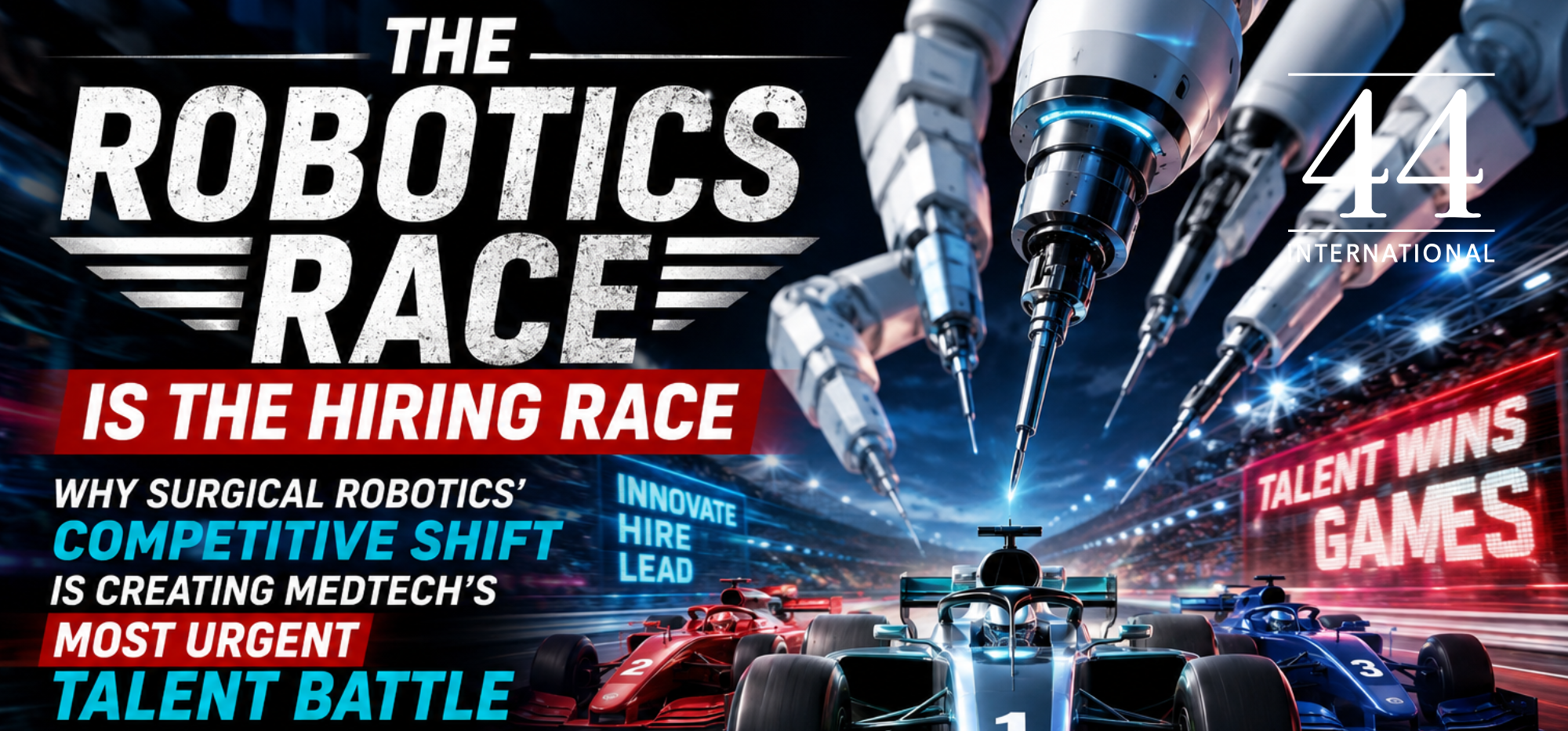
For more than two decades, the surgical robotics space was, to put it plainly, Intuitive Surgical's race to lose. The da Vinci platform sat so comfortably above the competition that the real strategic question for most MedTech players wasn't how to beat it — it was whether to try. That era is now over.
2026 has arrived with a fundamentally different competitive map. Medtronic's Hugo received FDA clearance for urologic procedures in December 2025, marking its first U.S. soft-tissue indication after years of international experience. CMR Surgical's Versius Plus secured clearance for cholecystectomy and has begun U.S. commercialization. Johnson & Johnson's Ottava submitted to the FDA in January 2026 and posted positive pivotal study results in May. A wave of smaller players — SS Innovations, Distalmotion, Moon Surgical — are filing and launching with ASC-focused designs that traditional hospital-centric platforms never prioritized. Intuitive, for its part, is not weakening; the company raised its 2026 procedure growth guidance earlier this year, and its installed base hit 11,106 systems by end of 2025. What has changed is not Intuitive's strength. It's the formation of a credible, funded, FDA-cleared competitive tier around it.
The market is responding accordingly. The global surgical robots market is projected to grow from $13.69 billion in 2025 to $27.14 billion by 2030, at a 14.7% CAGR. The AI-enabled segment of that market is growing even faster, at 17.8% annually. And a Medicare reimbursement change effective January 1, 2026 — expanding which procedures can be performed and billed in ambulatory surgery centers — has added a structural tailwind that will accelerate outpatient procedure migration for years to come.
All of which sounds like good news for the industry. And it is. But embedded within this competitive surge is a talent problem that most of these organizations are not yet fully reckoning with.
When multiple well-capitalized companies race to build the next generation of surgical robotics platforms simultaneously, they don't just compete on technology and clinical data. They compete for engineers. The profile this market demands — someone who combines advanced robotics software development, AI and computer vision expertise, real-time controls experience, and enough understanding of clinical environments to build for them — is extraordinarily rare. And right now, every major player is chasing exactly that person.
The numbers tell the story clearly. There is currently one qualified robotics candidate for every 3.1 open roles in the sector, with specialized positions averaging 114 days unfilled. Senior robotics software engineers are commanding $200,000 to $270,000 in base salary. Controls engineers are clearing $225,000 to $305,000. Engineers with robot learning and AI model training experience — the profiles driving the next generation of AI-assisted surgical systems — are earning $250,000 to $345,000 at the senior level, with foundation-model specialists clearing $475,000 in total compensation at the most competitive programs.
Those numbers would be striking in any industry. In surgical robotics, they're complicated further by a force most MedTech hiring teams haven't fully priced in: the humanoid robotics boom.
Humanoid robotics funding climbed from $239 million in 2022 to $3.7 billion in 2025. Figure, Apptronik, 1X Technologies, Boston Dynamics, Tesla, and Physical Intelligence are all actively recruiting — aggressively — from the same senior talent pool that surgical robotics companies depend on. The controls engineer your team needs to refine force-feedback haptics is the same controls engineer that Apptronik is recruiting for Apollo's joint actuator systems. The AI/ML engineer your platform needs for autonomous surgical gesture recognition is the same engineer Physical Intelligence raised at a multi-billion-dollar valuation to recruit.
This isn't a future risk. It's the current reality. Robotics software and AI companies are paying a median of approximately $198,000 for senior robotics talent. Traditional MedTech employers, by comparison, have historically paid around $102,000 for equivalent skills. That gap doesn't disappear because your mission is more meaningful. It has to be closed by intention — through compensation restructuring, equity design, and a fundamentally different conversation about what it means to recruit in this space in 2026.
The movement of robotic procedures into ambulatory surgery centers doesn't just change where surgery happens. It changes what companies need to hire for. ASC-segment robotic-assisted surgery is projected to grow at roughly 16% CAGR through 2031 — materially above the broader market. ASC buyers evaluate robotics through a completely different economic lens than academic hospitals. They care about price, per-procedure economics, room turnover, staffing burden, and time to break even.
This creates demand for a commercial talent profile that most surgical robotics companies built their go-to-market teams around hospitals don't naturally develop: sales and clinical specialist talent that can speak fluently to outpatient economics, understands the operational realities of leaner ASC environments, and can build physician relationships outside the traditional academic center ecosystem. The competitive advantage in ASCs won't come from the robot alone. It will come from the people who can place it, train on it, and support it in a setting that operates nothing like a major medical center.
Layered beneath the engineering and commercial talent crunch is a regulatory dimension that compounds all of it. Each new entrant navigating FDA clearance for expanded indications — Medtronic seeking clearance for Hugo in additional soft-tissue procedures, J&J moving Ottava toward approval — needs regulatory affairs professionals who understand the 510(k) pathway, clinical data requirements, and post-market surveillance obligations for robotic-assisted surgical systems specifically. That is a narrow specialty. Across MedTech broadly, more than 87,000 life sciences roles are currently open in the U.S., with the workforce running roughly 35% below industry demand. Regulatory and compliance skillsets are the hardest to source, cited as a gap by 36% of hiring organizations. When multiple companies are simultaneously pursuing new indications, the competition for this talent doesn't just tighten — it spikes.
The organizations that win the surgical robotics market over the next five years will not simply be the ones with the best platform or the deepest clinical data. They will be the ones that recognized early that competitive advantage in this space is built on the same substrate as every other kind of technology advantage: the people who build it, sell it, and support it.
That means treating talent strategy as a product strategy decision, not an HR function. It means understanding that your competitors for engineers are no longer just Intuitive or Medtronic — they are Figure and Physical Intelligence and every other well-funded program with equity to offer. It means building compensation structures that reflect the reality of 2026 robotics talent markets, not the benchmarks from 2020. And it means starting talent conversations now, before the role is open, before the clearance lands, before the launch date is set.
The robotics race is real. The market data confirms it. But the companies positioning themselves to lead it are the ones who understand that you can't win the product race if you're losing the hiring race first.
44 International is a specialist recruitment firm working exclusively in MedTech, life sciences, and healthcare. We partner with surgical robotics, medical device, and digital health organizations to build the teams behind the technology.

© All rights reserved